Blair’s Life Story
A memoir of life in England and then New Zealand, covering childhood, education, sport, travel, career, and family, as experienced by Blair.
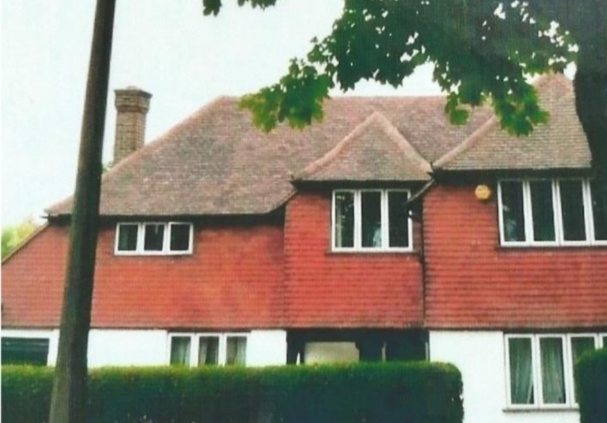
From younger days
I was born at 15 The Downsway, Sutton, Surrey, England, of Scottish parentage. My father was Thomas Blair Harvey, born at Murrayfield, Edinburgh. My mother was Susan Moon Mitchell, born in Inverkeilor, Angus, Scotland.
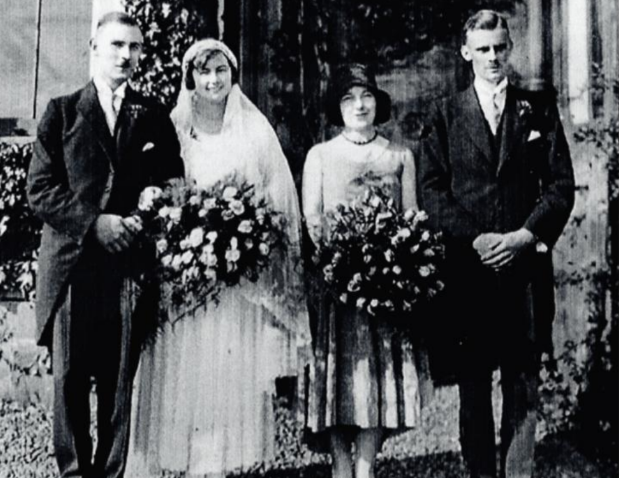
My parents married in 1930, Two sisters married two brothers and they all became Harvey’s; the families were very close friends. Thomas Blair Harvey married Susan Moon Mitchell and Dad’s brother; Robert Harvey married Margaret Ann Mitchell.
Thomas, Susan, Margaret and Robert Harvey.
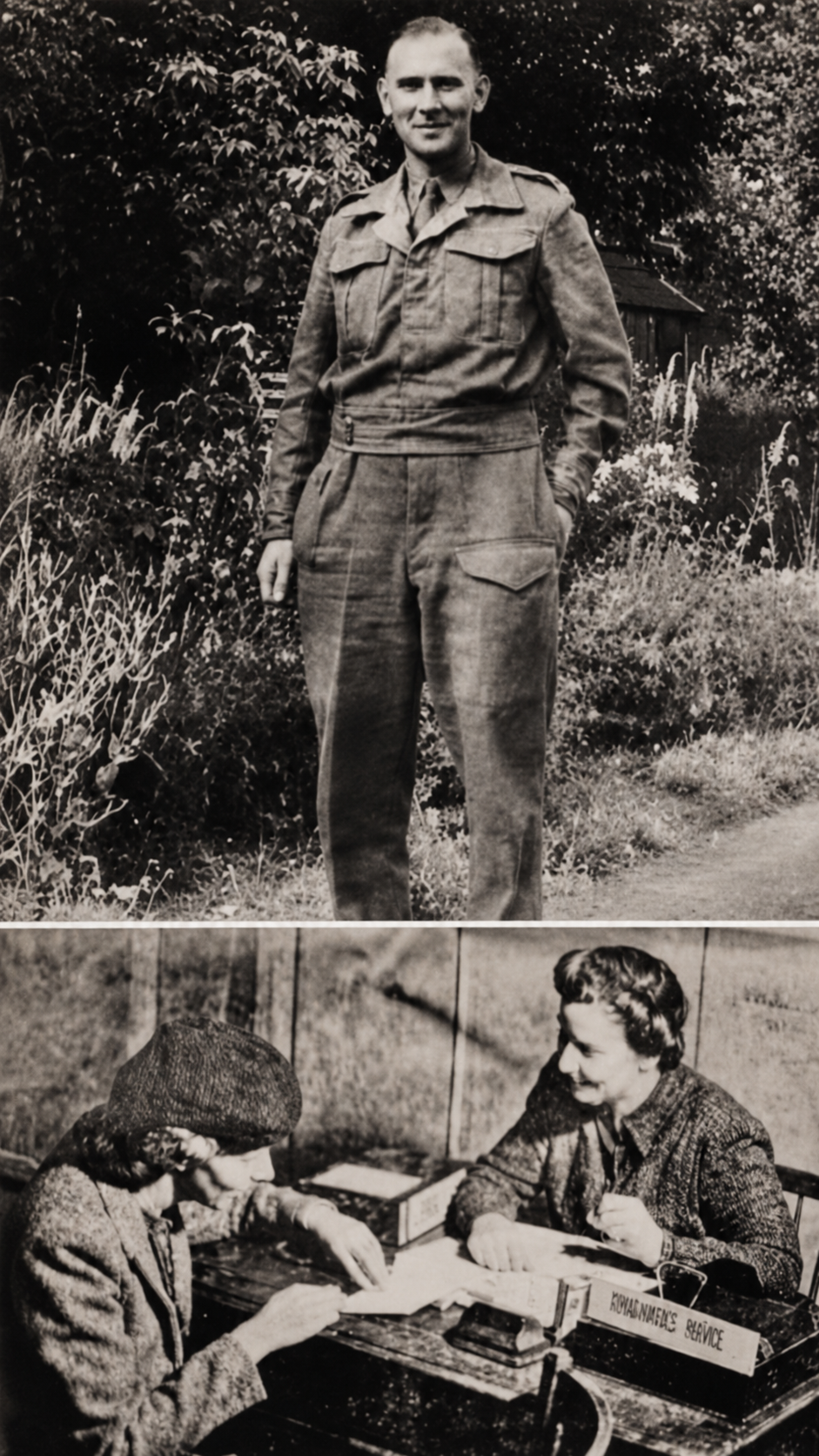
My Dad was a doctor, he had a practice in Sutton, Surrey. While my mother was a doctor's wife; she had to entertain. Uncle Robert, was head of the British Post Office. He had some job during the war which we never knew about, it was a secret, he was knighted as a Knight of the Bath.
The first real birthday present I remember was a Trix Twin train set, which was electric. I got that for my third birthday and Christmas present; being birthday and Christmas one week apart. Dad set it up, and we played with it.
My cousin, Ian, spent most of his time at our place, we had more toys. Although we lived two miles apart, we became firm friends.
Then the war came
In 1939, Dad was sent up to Catterick, which was a training ground for the army. From there he was sent to India, where he was in charge of five hospitals, his rank got up to Lieutenant Colonel.
My mother had a hard time, as she was a fire watcher, and one of the main people in the Citizens Advice Bureau in.
Sutton, Surrey, where she had to stay for the duration of the whole war, helping people out with various aspects of accommodation when they got bombed out, and such like.
I remember yelling out to mum, “Oh come and see these two planes chasing one another!” I was told to get inside very quickly, because they were shooting each other as they flew over the top of us.
On another occasion, around 1940, Mum woke us and told us to have a look at London on fire. We could see the fire of the bombing from our place; it lit up the whole sky.
We had sandbags covering some of the bottom story of our house, and our kitchen was shored up with heavy wooden beams across the ceiling and all-round the room. It was a big kitchen, if there was an air raid, we all slept under a big Morrison table that was assembled in there, including the two maids. Mum, of course, was outside fire watching.
There was a large battery of anti-aircraft guns on the Brighton road, which was virtually 200 yards away, down the bottom of The Downsway, on the main road. If there was an air raid, they’d keep going during the whole raid, and they made a hell of a din; very loud and deafening!!
We were the first real bit of township; Sutton was right on the edge of the London area, twelve miles from the centre and we copped quite a bit. One night, there was a fairly heavy air raid, and the bombs were close, we were lucky. There were quite a few big holes around our way; a bomb makes a big hole.
One breakfast, the sirens went off and we felt a thud, but heard no bang, our next-door neighbours said “We were very lucky.” Their daughter had just come out of her room for breakfast, came downstairs, had forgotten something and went back up, she had no bedroom!! The bomb went right through her bedroom.
Learning to golf
Before the fly bombs came, Dad came home on leave, in about 1942. It took him three days to fly from India to London, and we all went up to Scotland for a holiday. Stayed at our grandmother’s, and we went to Rothesay, on the Isle of Bute.
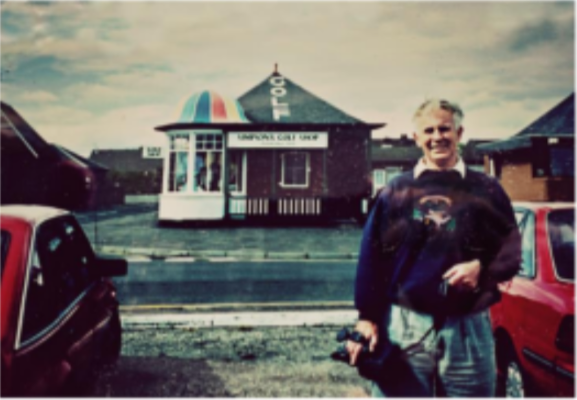
Dad said, “Oh, I think I'd better get you playing golf.” So, he took me to Simpsons Golf Shop in Carnoustie, and he talked to the pro there. The pros were all in little separate shops of their own, I got eight lessons of golf with Jack McLean.
I was six years old and given one club, which was the only club I was allowed to use for three years, until after the war. I had to be
able to play out of bunkers, I had to do everything with it, all with a 3 iron.
Off to school
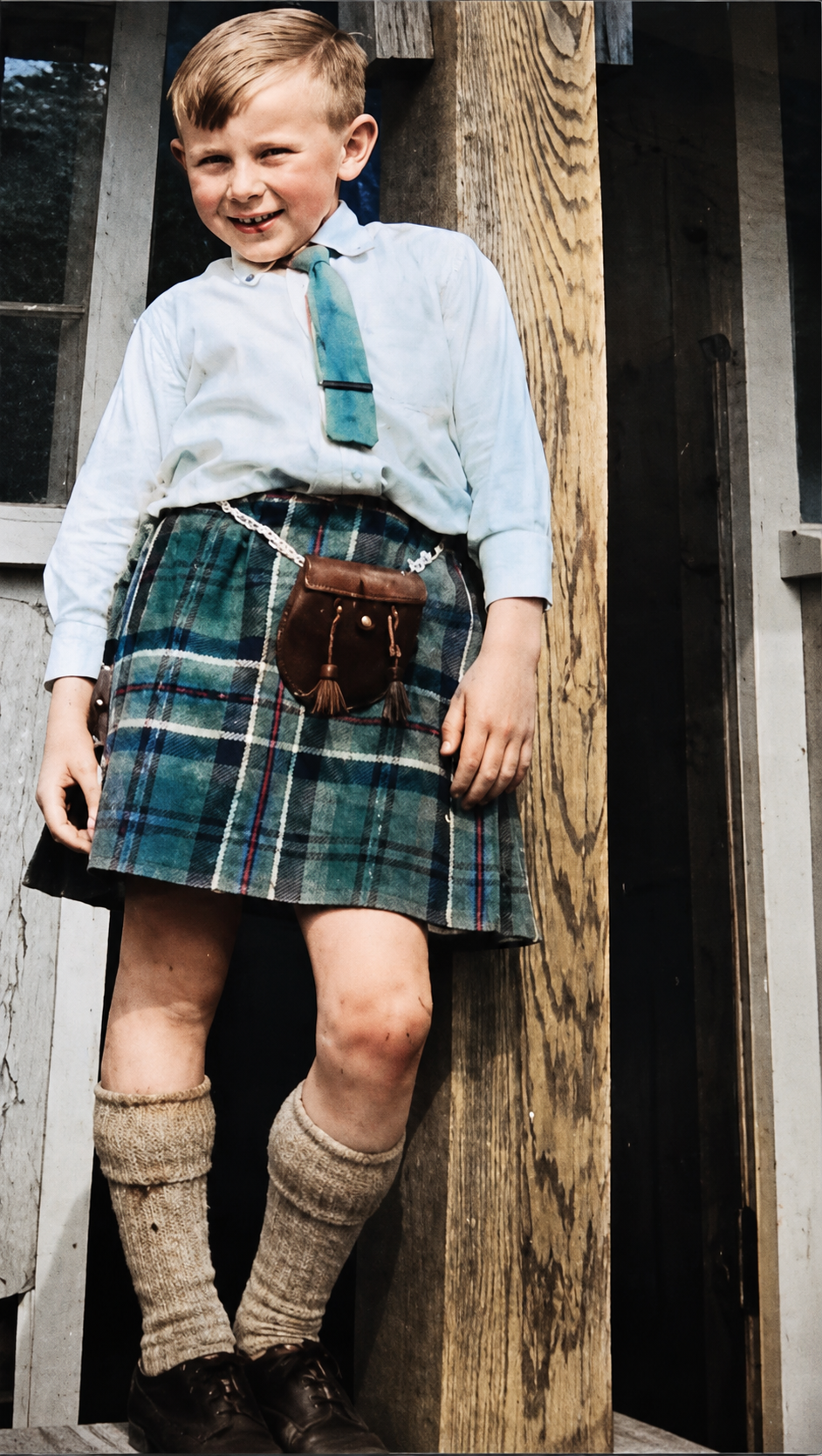
We went back down to Sutton, and Dad returned to India. The first day of school, I wore a kilt and I was teased a lot, because it was an English school. The next day I wore trousers, but I was very uncomfortable in them.
The headmaster said, “Why are you wearing your trousers? Wear your kilt tomorrow, and I’ll wear mine.” After that, a kilt became a second uniform for Aberdour Primary School. Clothes were expensive during the war; The Kilt lasts a damn sight longer than trousers.
I heard not too long ago there was about thirty boys still wearing a kilt. There was about twelve in my day: in a school of about one hundred, twelve percent is not too bad.
One day the conductor said “Hey, you wearing a kilt. Catch up with us.” He put out his long ticket holder, I grabbed hold of that, and he pulled me right up to school.
I would cycle to school; it was three miles cycling uphill all the way from home to school. Mum was too busy and no dad around. Quite often a bus used to overtake me, the buses were Double-decker buses, old AECs and they climbed the hill fairly slowly.
I can't remember which year it was, I was in a French lesson, and we heard a plane coming fairly low. The French master never spoke English, we had to know what he was saying.
There was a big bang, it was the tower on the top of the school getting knocked off. It came through just next door to our classroom.
It was one of our planes, what was known as a Lightning, twin fuselage. It had been damaged badly over in Germany. The plane was trying to get onto the golf course, because there were quite a few houses around. Although the school tower got knocked off, he did get onto the golf course.
When I was cycling home, I saw where the plane had crashed and went home and said, “Oh, mum, there was flesh on the trees.” She said “Rubbish.”
All the kids at school used to collect shrapnel. We all had little boxes of shrapnel and incendiary bomb cases, it was all over This time he spoke English, "Get under desks!”
the place after a night raid. It was sharp jagged pieces and we used to collect it and swap pieces. Good swaps, it was fun.
Dundee
The Flying Bombs started around late 1943, we had 22 within a quarter-mile of where we lived. Mum sent us up to Dundee to stay with our grandmother, and we were there until V-E Day (Victory in Europe Day).
We stayed with our grandmother in a flat in Airlie Place, my sister (who was 3 years older than me) and I shared a bed. She used to send us to bed at six o'clock
When we went to school in Dundee, they couldn't understand us; we spoke with an English accent. Then when we came back home and went to school, they couldn't understand us again. The Dundee accent is terrible.
Every night. However, during the summer, Dundee never gets dark until half 11 at night.
Just at the right height, there was a stone wall between the circle of flats, Shoena and I used to sneak out through the window on the stone wall. We’d go play with our friends and then sneak back in the same way. I'm sure my Auntie Anne knew what we did, but she never said a word.
Mum came up for a short holiday (as she had to stay on in London at that point), she had her elbow on the mantelpiece smoking a cigarette and she fell asleep. Luckily, we were around to pick up the cigarette. Dad smoked, but it was the first time we saw Mum smoking a cigarette.
The night of V-E Day, we went back to London by the night train and there were bonfires all the way down the line, people had lit them in celebration. It was tremendous and a lot of fun.
Back to normal
Late 1945, Dad came home before V-J Day (Victory over Japan Day) and we went back up to Scotland to see his step-mother. Thomas Harvey had three wives; the first one died having one child, his second wife had Dad and Robert. He married again and we called her Granny Harvey. Dad wanted to see them, and his sister, Mayme, who lived in Glasgow.
We went up to Dundee again, and he said, “Oh, we'll go and see the pro again at Carnoustie.” I got another four clubs; a wood, a five-iron, a pitching iron or a mashie niblick, and a putter. So that made up a full set, as far as I was concerned. Great fun, after a good holiday up there, Mum stopped smoking now Dad was home, but Dad didn't.
Dad got back into practice in Sutton, Surrey, and also as a physician at the Sutton and Cheam hospitals. Mum reluctantly gave up her assistance at the Citizen Advice Bureau, she had gotten used to being her own boss. When they went back to supposed normal, it was back to being the doctor's wife. She had trained as a gym teacher at Dunfermline College. While her sister, Auntie Anne, was a district nurse, and Auntie Margaret, was a lady.
Dad showed me how to cut the grass with a motor-mower, it was a crank handle to get it started. I did all the grass for him, from about the age of eight or nine. It was fun, but it was a two-stroke motor, and it took a lot of starting. I couldn't do the bank with the motor mower, because it didn't like climbing, so I had to stand at the top and let a hand-mower run down, then pull it back up with a rope.
I can remember helping Mum hanging out the washing, the maid usually stayed and did most of the housework. We only had one maid then; her name was Chrissie. We had a great big roller iron around for doing sheets. It was almost an industrial sized one, shirts and sheets, but not underclothes got ironed. It did the sheets nicely, but who would iron sheets these days?

Aberdour School was good, I made the First Eleven cricket team, and the First Eleven soccer team for a couple of years. I’ve always been sporty, we played rugby too, but I didn't
enjoy that so much. Mind, soccer's fairly rough these days.
I still wore my kilt, it became an optional uniform, because coupons were required for clothing. If you used too many on clothing you didn't get enough food. I can't remember how
many we got each but you had to make it work out.
Time for a change
At the beginning of 1948, Dad said, “I do not enjoy the National health scheme.” You've got to have 3,000 patients to qualify. “You can't service 3,000 patients with one person.” He
then said, around about Christmas time, “We're going to sell up and we're going to take the first boat either to South Africa or New Zealand.”
The first boat sailing with passengers, requiring a ship's doctor, was the New Zealand Star of the Blue Star line, it left at the end of December 1948. I missed my cousin, because he
used to come over and play with me, more than I went over to his place, we had a
lot of good times together.

Blair, Shoena and Ian
The trip to New Zealand, we had to hove to on the Bay of Biscay for four days, I was so seasick for those four days but I have never been sea sick again since. We stopped at Curacao, for more oil and for the motors, then through the Panama Canal and stopped at Pitcairn Island.
The whole ship had doubled up on passengers, there were supposed to only be 12, but there was 30. It was a big crowd, we had deck golf on board, and they put up a canvas
swimming pool when we got into the tropics.
We were in one of the few cabins that had a bathroom and we had filled the bath with pineapples, at Pitcairn Island, we had pineapples for the rest of the voyage to New Zealand. We had a great time and it was a good voyage out.
We arrived in Auckland New Zealand on the 7th of February, 1949 and we stayed with friends of Dad's, a Doctor, Mrs. McWhirter, and their daughter Judith for a couple of days,
before taking the night train down to Wellington.
Mount Ngauruhoe was blowing its top, and the train stopped for everybody to have a look at Ngauruhoe, it was quite spectacular with volcanic plumes and lava that overflowed the
northwest side of the cone.
We arrived in Wellington and were met by a person we had known in England, Jack Kerr, he was also a doctor. They used to live in Brighton, in the UK, Mum's second cousin, Grace
Micthell married Dr. John, he was known as Jack Kerr.
They had arranged for Shoena and I to come up to Wairarapa and go to school, while Mum and Dad went round the whole of New Zealand to see where they would like to set up.
One of the best positions was in Masterton, Dad was made a consultant physician at the
Masterton Hospital, and he settled in there after about four months



Biographical Overview
Blair’s early family arrangement saw Shoena and Blair sent to the Wairarapa region to attend school while their parents travelled around New Zealand deciding where to settle professionally. Eventually, their father established himself in Masterton, becoming a consultant physician at Masterton Hospital after a short period of adjustment. The family home was set up at 89 Renall Street, which also doubled as both residence and medical consulting rooms, with their mother working as receptionist and helping run the practice. This created a lively, socially connected household embedded in the local community.
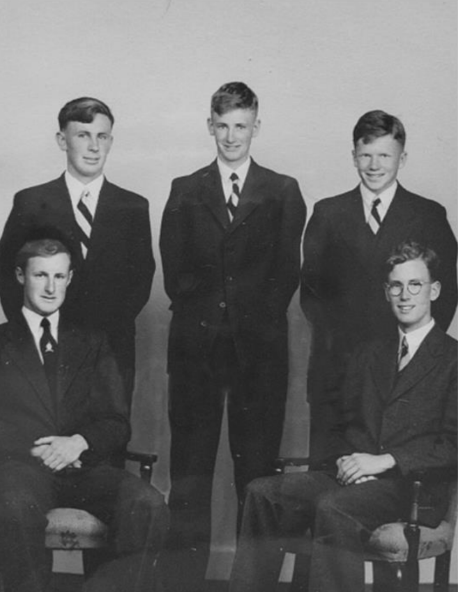
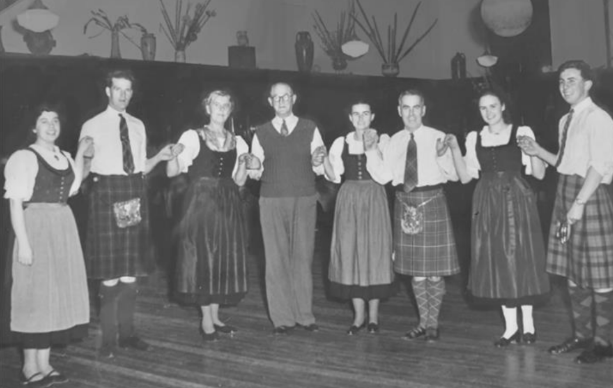
Blair’s school life began at Wairarapa College, where he and Shoena were introduced publicly by the headmaster after arriving in kilts—an event that became memorable and frequently recalled by others. Soon after, they had to adopt standard school uniforms, marking a shift from their earlier attire and boarding arrangements. Shoena boarded at Purnell, while Blair stayed at College House and later lived locally once the family secured nearby accommodation.
A strong sense of independence developed during this time, including visits to rural areas such as Mangamaire between Eketahuna and Pahiatua, where Blair formed friendships and experienced farm life activities such as rabbit shooting. Meanwhile, their father achieved a notable medical milestone by being among the first in New Zealand to use a portable heart tracing machine (early ECG technology), charging significant fees for the service at the time.
A serious turning point occurred during a horse-riding accident at Te Kopi Road in Masterton, where a jump over a ditch resulted in a broken leg involving both bones. The injury led to hospitalisation and a long recovery, including a missed term of school and ongoing physical consequences due to metal plates remaining in the leg. This period also coincided with challenges at school, including being held back in the fourth form at Whanganui Collegiate School, where Blair struggled academically and socially, partly due to dyslexia, a severe stutter, and the effects of prolonged illness and recovery.
Despite these difficulties, sport—especially golf—became a major outlet and defining strength. At Masterton Golf Club, Blair trained regularly and developed a close friendship with contemporaries, including Bob Charles. Practicing frequently during school holidays and weekends, he refined his skills through repetition, distance judging, and bunker practice. This dedication eventually led to competitive success and a steadily improving handicap.
Golf continued strongly during school years at Whanganui, including regular play at Belmont Golf Course and structured school routines involving chapel, lessons, and restricted weekend freedoms. Despite success in sport, school life remained difficult due to bullying and strict discipline practices typical of the time. Eventually, Blair achieved prefect status, which reduced bullying and increased authority among peers.
After completing university entrance, Blair was directed toward medical studies at University of Otago, though without strong personal enthusiasm. While living at Knox College, he attended some lectures and passed certain subjects like chemistry, but did not pursue medicine seriously. Instead, golf remained a major focus, including participation in university competitions and achieving multiple holes-in-one—eventually totalling seven across different courses and years.
One of Blair’s most significant golfing achievements was winning the Otago University championship in 1956 under difficult weather conditions. Alongside sport, there were notable social experiences, including an encounter with the von Trapp family during a visit to Masterton, where they visited the family home and participated in informal cultural gatherings.
After leaving university, Blair moved into farm work at Caves Road, working with livestock including Aberdeen Angus cattle and Romney sheep. This period involved early morning routines, physically demanding labour, and exposure to rural New Zealand farming practices. The work was hands-on and sometimes dangerous, including being thrown by a bull during veterinary treatment of animals.
A major transition followed with travel to the United Kingdom alongside a friend, involving long sea journeys via multiple countries and ports including Australia, Asia, and the Middle East. Upon arrival, Blair took various jobs, including market research at Paddington Station and even temporary work as a chauffeur driving a Rolls Royce. Social life included staying with relatives in Surrey and travelling to Scotland, where connections to Aberdeen Angus farming continued.
Extended travel across Europe followed, including France, Spain, Italy (Rome, Venice, Pisa), Switzerland, Germany, and the Netherlands. Living conditions were basic, combining camping and van travel, but the experience was broad and exploratory. Work in the UK included roles in advertising, catering administration, and later farming again in Oxfordshire (Banbury area), where Blair managed livestock, crop work, machinery, and general farm operations on a large property.
During this period, farming responsibilities expanded significantly, including sheep management, shearing, and introducing more structured livestock practices. Blair also balanced rural work with regular travel to London for social life. Eventually, after several years abroad, he returned to New Zealand.
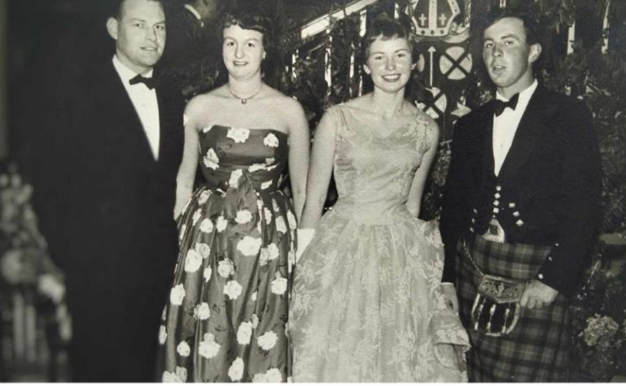
Back in New Zealand, life transitioned into long-term employment and family development. Blair met Judy in Wellington through family connections and eventually became engaged and married at St Mark’s Church, Wellington in 1962 after an 18-month engagement. The relationship became central to his life moving forward.
Professionally, Blair worked across several accounting and finance roles, beginning with Guardian Assurance, then moving to C&A Odlins where he played a key role in modernising systems, including introducing early computerisation using punch cards. He also helped establish company golf tournaments that grew significantly in size and participation over the years. Later roles included senior finance positions at Carlton Carruthers du Chateau and New Zealand Van Lines, where he identified accounting errors, improved systems, and implemented computer networking across multiple branches.
Despite professional success, later employment also brought stress, particularly in high-pressure financial management roles. Eventually, Blair stepped away from corporate work, returned to the Wairarapa, and undertook smaller accounting and advisory roles, including helping struggling businesses remain solvent.
Family life continued alongside this career path, with children born between 1965 and 1973. Education and schooling for the children were locally based, and family life remained closely connected with both sets of grandparents and extended relatives. Over time, Blair transitioned fully into retirement, reflecting on a varied working life that combined farming, sport, international travel, and finance.
Create Your Own Website With Webador